From Dashboards to Bots: G-Square’s Real-Life Agentic AI Chatbot Use Cases
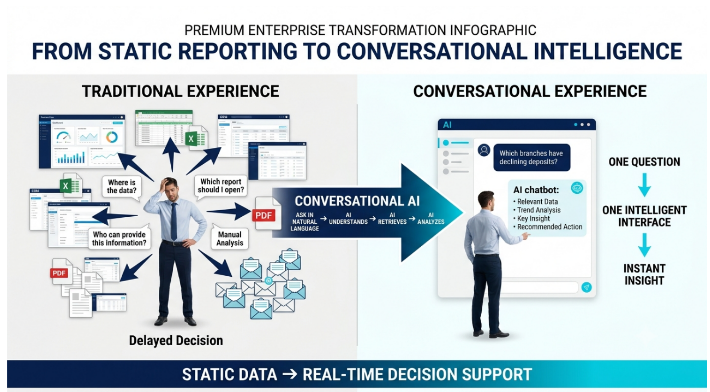
Organizations today have access to enormous amounts of data, dashboards, CRM systems, SOPs, and reports. The challenge, however, is simple: getting the right information at the right time should not require navigating multiple systems or waiting for a report.
Over the recent past, G-Square has applied Conversational AI across multiple business domains, proving that a chatbot is not just an FAQ tool—it can become an intelligent interface between users, enterprise data, knowledge, and business workflows.
Real-Life Use Cases
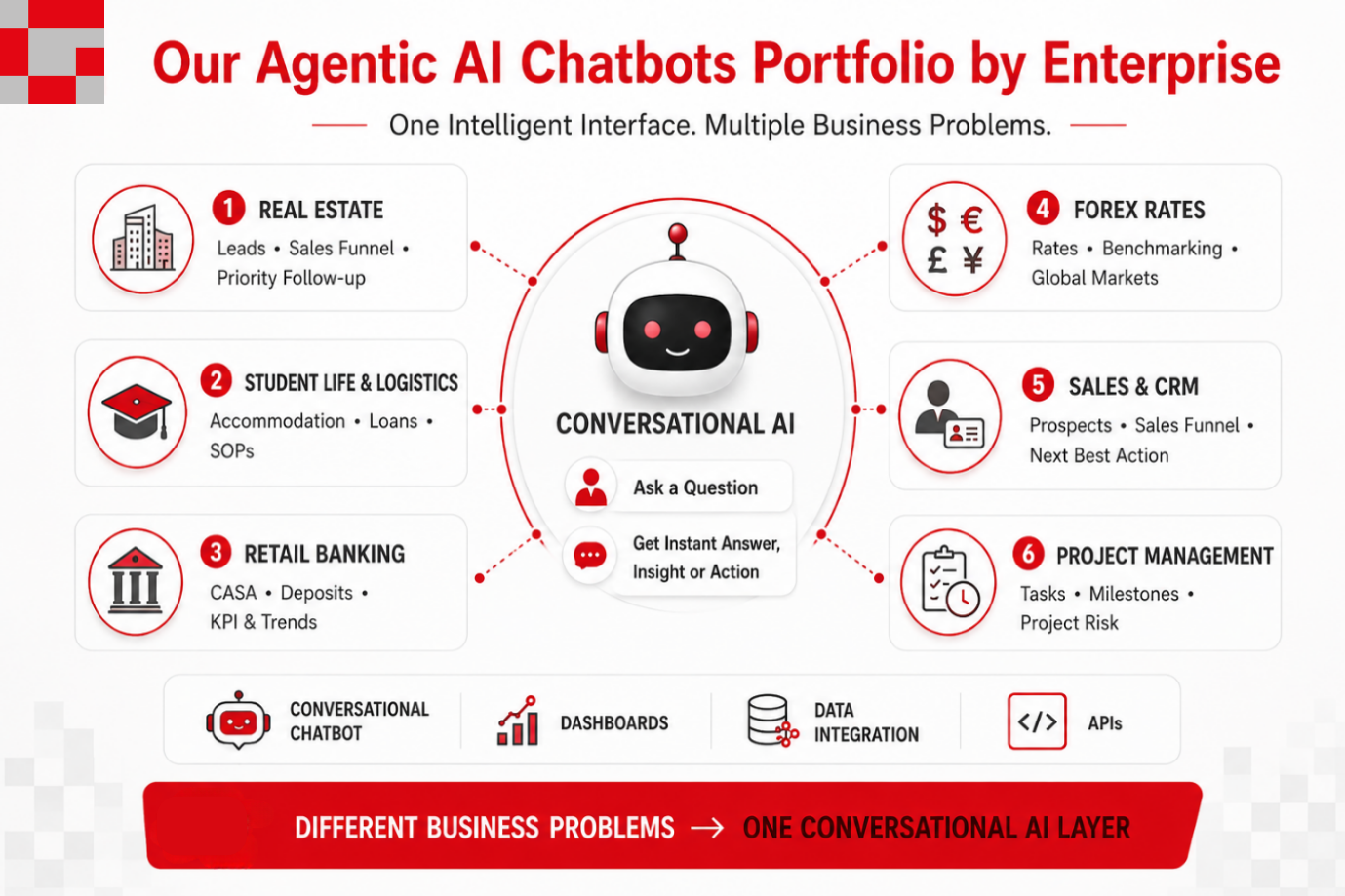
- Real Estate Sales
A chatbot helps capture and analyze property enquiries from inbound channels, qualify prospects based on budget, location, and intent, and identify where leads are getting stuck in the sales funnel.
“Show me high-intent prospects in Mumbai who have not been contacted in the last three days.”
The system can instantly retrieve the relevant information and help the sales team prioritize action.
The result is a shift from reactive reporting to proactive lead management
- Student Life & Logistics
Sales & Operations teams are conversationally querying Property & Loan portals for rate comparisons, access Datawarehouse, document checklists, agreement clauses and closure SOPs, reducing dependency on operations and compliance teams.
“What documents are required before closing a commercial rental agreement?”
Or:
“What are the best options for a 10-year student loan if my parents’ financials are weak?”
The chatbot can retrieve the relevant portals, SOP, identify the applicable process, and provide the required steps instantly.
This reduces operational dependency, minimizes repetitive queries to support teams, and helps transaction teams move from question to action much faster.
- Retail Banking Assistant
Business users can ask for CASA, deposits, growth trends, branch performance, and liability metrics without manually navigating dashboards or reports.
“What is the CASA ratio for my branch?”
“Which branches showed the highest deposit growth this quarter?”
“Compare current-year deposit performance with last year.”
The AI assistant can retrieve data based on the user’s role, branch, region, or business segment and provide the relevant information in an instant conversational response.
- Forex Rate Competition Analysis
Forex teams can benchmark competitor interest rates across currencies and tenures, helping reduce manual comparison of market rate sheets.
“Compare our USD/INR rate with key competitors.”
“Which bank is offering the highest rate for a six-month FCNR deposit?”
“Show the difference between our rate and the market average.”
The AI layer retrieves the relevant market and competitor information, processes the comparison, and presents the insight directly.
- Lead Funnel Bots
Sales managers can instantly ask about a prospect’s current stage, last interaction, ownership, pending action, and next best step instead of searching through CRM screens.
- Project Management Tracking – AI Updator
Team members can provide project updates conversationally, while AI identifies the task, status, delay, dependency, blocker, and impact. Management can then ask for delayed tasks, project risks, or key changes since the previous update.
One Common Architecture Behind Every Use Case
Although the business problems are different, the underlying approach remains similar:
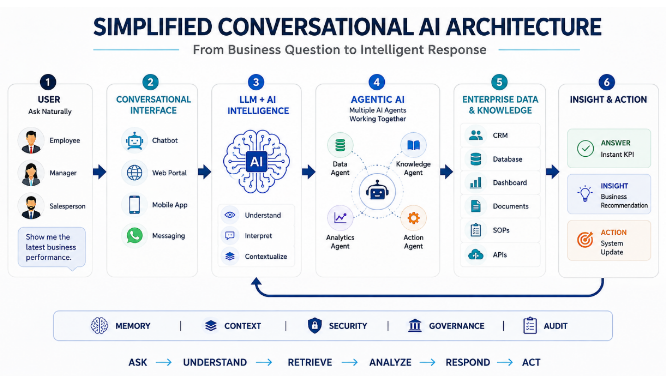
The Agentic AI layer can intelligently connect with different enterprise sources such as:
- CRM and Campaign management tools
- Databases and Data Warehouses
- Multiple File formats
- SOPs and Policy Documents
- Project Management Tools
- APIs and Market Data
The AI determines what the user is asking, identifies the relevant data source, retrieves the information, performs analysis where required, and delivers a contextual response.
A memory and storage layer can maintain conversation history, user context, previous queries, actions, and audit trails—allowing the conversation to continue naturally.
 Next Chatbot Developments at G-Square
The same conversational AI architecture is being extended into several other areas:
- Overall Executive Intelligence – Business performance, risks, trends, and management insights.
- Financial & Regulatory Reporting – P&L, Balance Sheet, FTP, NII, NIM, RAROC, and regulatory metrics.
- Compliance & Policy Assistant – Conversational access to policies, procedures, and regulatory requirements.
- Risk Monitoring – Portfolio deterioration, threshold breaches, and exception analysis.
- HRM Modules– Policies, workforce information, employee KPIs, and internal processes.
- Customer Service Bots – Customer 360, interaction history, query resolution, and next best action.
- Procurement & Vendor Intelligence – Vendor performance, spend analysis, contract tracking, and delivery risks.
- Knowledge Assistant (SOPs) – Instant conversational access to enterprise documents and knowledge repositories.
- Operations Bots – SLA breaches, pending approvals, failed processes, and operational exceptions.
- AI Sales Coach – Lead prioritization, conversion probability, recommended follow-ups, and next best actions.
The Bigger Opportunity
The real opportunity is not simply to build another chatbot.
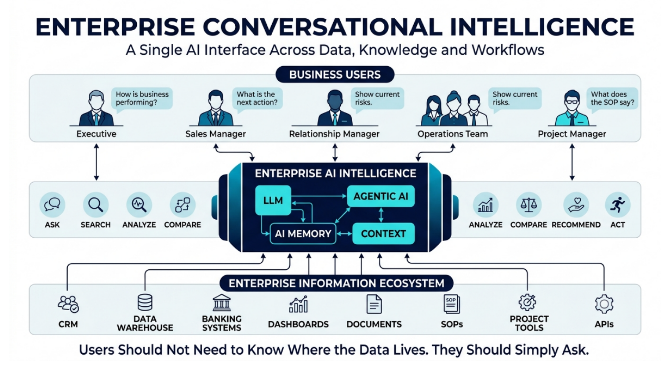
It is to create an Enterprise Conversational Intelligence Layer—a single interface through which users can access fragmented data, search knowledge, generate insights, and eventually trigger business actions.
The philosophy is simple:
Users should not need to know where the data lives, which dashboard to open, or how to build a report. They should simply be able to ask.
That is how static reporting evolves into real-time, conversational decision support.
Follow