Problem & Solution
Sharing our experience on how we improved the data backbone for a US-based debt fund replacing manual, multi-tool reporting with one automated & trusted platform.
For fund administrators managing a US-based debt fund, one of the quiet operational drains is rarely the investment strategy itself, it’s the data issues underneath it. Transaction records, FX rates and reporting metrics often live scattered across spreadsheets and disconnected tools, forcing teams to reconcile numbers by hand before anyone can trust a dashboard, let alone make a risk call.
The objective was to manage & optimize the existing data infrastructure supporting the fund’s end-to-end operations, then build the pipelines and reporting layer on top of it. In practice, that meant three things working in concert: a properly engineered database and infrastructure layer, automated pipelines handling the ingestion, transformation and delivery of fund and FX rate data, and a single consolidated dashboard replacing what had been a fragmented, multi-tool reporting environment.
Tech Solution
The diagram below shows how data now moves through the system: third-party sources – the fund management vendor and FX rate APIs and internal sources internal databases and Excel-based utilities all feed into a single ETL & API integration layer. From there, data lands in a governed data platform and database, flows through vendor and internal data processing and surfaces through one centralized dashboard covering fund transactions, FX rates, fund metrics and reporting feeding directly into fund management, reporting and risk assessment.
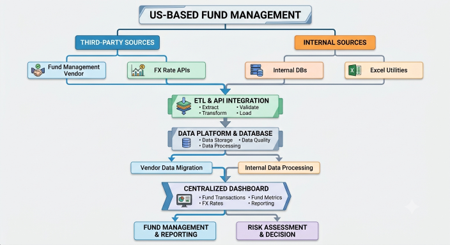
End-to-end data flow: from source systems to centralized dashboard to decision-making
Steps Involved
The resulting solution is best described as a consolidated, automated data layer, one that supports transaction monitoring, reporting, and risk-based decision-making from a common foundation.

The solution flow: from transaction monitoring to operational efficiency
Fund transactions and FX rates now flow through automated ETL and API-based processes rather than manual uploads. Data from multiple upstream sources is unified before it ever reaches risk teams screen. And the people who need that information whether for daily operations or risk assessment get it through one centralized dashboard.
Solution
The business impact shows up in a handful of concrete outcomes. Data gaps and delays that used to slow down fund teams are gone, replaced by a single trusted source with automated refresh cycles. Manual, Excel-based workflows have given way to fully automated pipelines, cutting both processing time and the human error that comes with hand-built reconciliation.
Validation and reconciliation layers now sit between raw data and downstream reporting, so the numbers feeding risk and compliance systems are consistent by construction and not by chance. And because everything routes through one dashboard, stakeholders get a unified view of fund performance, FX exposure, and operational metrics instead of stitching that picture together themselves.
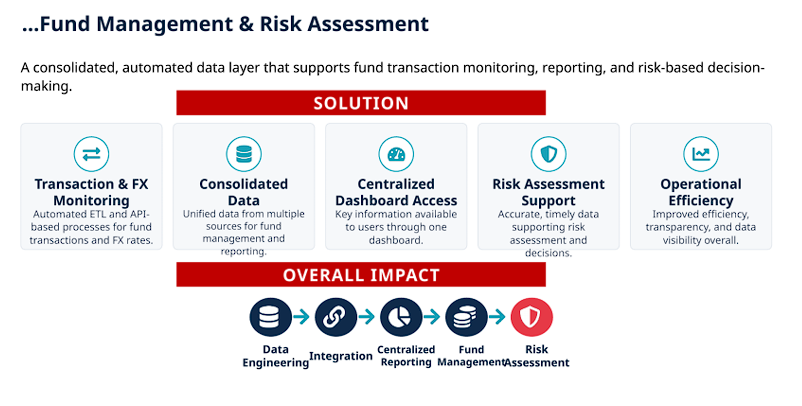
From engineering to decision-making: the overall value chain.
Perhaps the most understated line item in the original engagement summary is also the most operationally important: the migration to this new stack happened with zero data loss and zero operational downtime. For a live fund, that’s not a minor detail, it’s the difference between a modernization project stakeholders can trust and one they have to hold their breath through.
| Value Driver | Outcome |
| Data Reliability | Single source of truth, automated refresh |
| Operational Efficiency | Manual workflows replaced by automated pipelines |
| System Migration | Zero data loss, zero operational downtime |
| Dashboard Consolidation | Multiple tools → 1 centralized platform |
| Risk Assessment | Real-time, accurate data for decision-making |
Key takeaway
Underneath the technical detail, the throughline is simple: reliable data infrastructure isn’t a back-office convenience for a fund, it’s the precondition for faster, better-informed investment and risk decisions. Other fund management and capital markets clients can also get these efficiencies incorporated with our specialisation.
Follow