How AI is Rewriting the Sales Journey
Enhancing Customer Conversion
“The future of sales isn’t about replacing salespeople with AI. It’s about helping them engage customers faster, make better decisions, and convert more opportunities.”
- Background & Current Sales Processes
- The Sales Challenge Has Changed
Organizations today invest heavily in digital marketing, CRM platforms, sales teams, and multiple customer engagement channels. Every day, customers interact through websites, WhatsApp, emails, phone calls, chatbots, social media, and meetings.
Yet many qualified prospects never become customers.
The problem is rarely a shortage of leads. It’s a shortage of visibility.
Sales teams often know how many leads entered the pipeline but struggle to answer more important questions:
- Which prospects are ready to buy?
- Why was a deal lost?
- What objections were raised?
- Which opportunities need immediate attention?
- What should happen next?
The answers already exist within customer interactions—but they’re scattered across thousands of conversations and digital touchpoints.
- Why Traditional Sales Falls Short
A typical sales journey follows a familiar path:
Lead Generation → Qualification → Engagement → Proposal → Negotiation → Conversion
Every stage presents challenges.
Leads are not prioritized effectively. Customer conversations remain fragmented across channels. Sales representatives spend time on repetitive administrative work. Managers depend on CRM updates instead of real customer insights. As a result, opportunities are missed, sales cycles become longer, and customer experience suffers.
The issue isn’t effort—it’s the inability to interpret customer signals quickly enough.
- How AI Is Transforming Every Stage of Sales
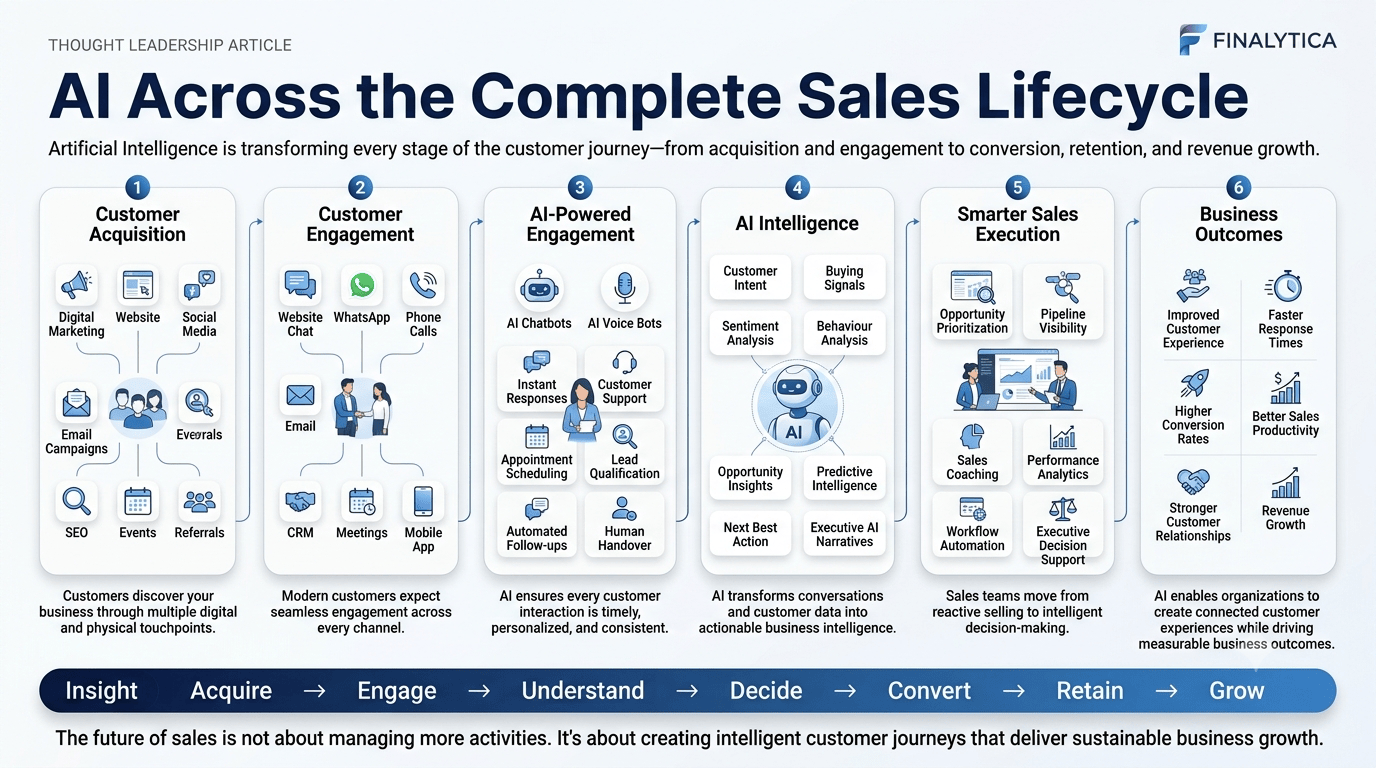
Artificial Intelligence is becoming an intelligent assistant throughout the sales lifecycle.
- Smarter Lead Generation
AI analyzes campaign performance, customer behaviour, and digital interactions to identify audiences with the highest likelihood of converting, improving lead quality rather than simply increasing lead volume.
- Intelligent Lead Qualification
AI evaluates incoming leads using behavioural signals, demographics, engagement history, and buying intent, automatically prioritizing the most promising opportunities.
- Always-On Customer Engagement
AI-powered Chatbots and Voice Bots engage customers 24×7 across websites, WhatsApp, mobile apps, and contact centres. They answer questions, qualify leads, schedule appointments, and seamlessly hand over complex conversations to sales teams.
- Understanding Customer Conversations
Modern AI can analyze conversations across calls, emails, chats, and meetings to identify:
- Customer intent
- Buying signals
- Objections
- Competitor mentions
- Sentiment
- Product interests
- Decision-makers
Instead of simply recording conversations, AI converts them into actionable business intelligence.
- AI-Assisted Selling
AI supports sales representatives by recommending the Next Best Action, generating meeting summaries, suggesting personalized follow-ups, identifying cross-sell opportunities, and highlighting deals that require immediate attention.
- Smarter Sales Management
AI enables managers to monitor pipeline health, identify reasons for lost opportunities, forecast revenue, detect coaching needs, and make faster, data-driven decisions.
- The Connected Digital Sales Ecosystem
AI delivers the greatest value when it connects every customer touchpoint into a unified ecosystem.
It integrates information from:
- Websites
- CRM platforms
- Emails
- Phone calls
- Social media
- Marketing campaigns
- Mobile apps
- Virtual meetings
Rather than isolated interactions, organizations gain a complete view of every customer journey.
- AI Enhances Human Relationships
AI is not replacing sales professionals—it is augmenting them.
By automating repetitive tasks and surfacing real-time insights, AI allows sales teams to spend more time understanding customers, solving problems, and building trusted relationships.
The most successful organizations will combine human expertise with AI-driven intelligence.
- How each Industry can solve the Sales problem using AI
While the sales process varies across industries, the underlying challenges remain remarkably similar—identifying the right prospects, engaging them at the right time, and converting them efficiently. AI-powered sales platforms are helping organizations overcome these challenges by combining automation, conversation intelligence, predictive analytics, and real-time recommendations to improve both customer experience and business outcomes
AI application Across Key Sales-Driven Industries
|
Industry |
Typical Sales Challenges |
How AI Improves Sales |
|
Banking |
High enquiry volumes, slow lead qualification, low cross-sell conversion, fragmented customer interactions |
Prioritizes high-intent leads, automates customer engagement, recommends next-best products, and provides conversation intelligence for relationship managers. |
|
NBFC & Lending |
Loan application drop-offs, document collection delays, manual eligibility checks, inconsistent follow-ups |
Pre-qualifies applicants, automates follow-ups and document reminders, predicts conversion likelihood, and improves turnaround time. |
|
Insurance |
Low policy conversion, missed renewals, complex product selection, inconsistent advisor follow-ups |
Identifies buying intent, automates renewals and reminders, recommends suitable products, and assists advisors with personalized customer insights. |
|
Wealth Management |
Managing large client portfolios, identifying investment opportunities, tracking client interactions |
Summarizes client conversations, identifies investment intent, recommends next-best actions, and improves relationship management. |
|
Real Estate |
Large digital lead volumes, delayed responses, poor lead qualification, site visit drop-offs |
Scores leads based on buying intent, automates follow-ups, schedules site visits, and predicts conversion probability. |
|
Retail & E-commerce |
Cart abandonment, inconsistent customer engagement, low repeat purchases |
Engages customers instantly, recommends products, personalizes offers, and predicts purchase behaviour to improve conversions. |
|
IT Services & SaaS |
Long sales cycles, demo scheduling, proposal delays, opportunity tracking |
Qualifies leads, automates demo scheduling and follow-ups, summarizes meetings, and provides pipeline intelligence. |
|
Telecom |
High acquisition costs, customer churn, upselling existing customers, multi-channel interactions |
Identifies churn risks, recommends upsell opportunities, automates customer engagement, and improves retention through AI-driven insights. |
- Looking Ahead
The future of sales belongs to organizations that can understand customers as quickly as customers expect to be understood.
G-Square’s Salesrator AI tool also comes handy in the AI driven sales from end to end.
By embedding AI across the entire sales journey—from lead generation and qualification to engagement, conversion, and customer success—businesses can improve customer experience, increase conversion rates, enhance sales productivity, and make smarter decisions. In the AI era, competitive advantage will not come from generating more leads. It will come from making every customer interaction more intelligent.
Follow